Cost and coverage
Vision insurance or medical insurance: which applies to an eye visit?
Your reason for care, exact plan and selected doctor all matter. Here is how to check coverage without guessing which card applies.
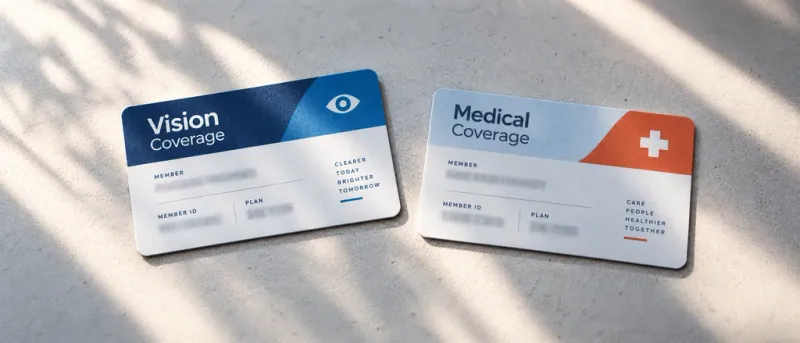
Vision benefits and medical insurance can apply to different parts of eye care. The reason for your visit, services provided, exact plan and participating provider matter. A familiar insurance-company name does not confirm coverage or your final cost.
Start with why you need care, not which card to use
You may have a vision-benefit card, a medical-insurance card or both. Begin by describing what brought you to the office: a prescription update, trouble with your eyes, or follow-up for an existing health condition. Mention all your concerns rather than choosing the description that sounds least expensive.
For instance, 'I need new glasses and I have been noticing a change in one eye' communicates more than 'routine exam.' You do not need to decide which diagnosis or billing code fits. Ask what can be assessed in the planned appointment and whether a separate service or visit might be needed.
Start with costs and insurance
What vision coverage means
Vision coverage helps pay for vision care such as examinations and glasses. It may be included in a health plan or offered separately. HealthCare.gov notes that only some Marketplace plans include adult vision coverage, so it is worth checking rather than assuming it comes with medical insurance.
Look beyond the word 'vision' on a benefit summary. Ask what the plan includes, any visit-frequency limits, how eyewear benefits work and which provider network applies. The questions for an examination can differ from the questions for frames, lenses or contacts. Keep the care and purchase portions of your budget separate.
Review vision insurance questions
Why a medical eye visit may be different
A visit about an eye condition can raise different coverage questions from a routine prescription check. An example is Original Medicare: it does not cover routine examinations for glasses or contacts, while Part B covers eligible diabetic-retinopathy examinations. Some Medicare Advantage plans include additional vision benefits. These examples do not establish Advanced Vision Care Center (AVCC) participation or describe every insurance plan.
Having a diagnosis does not make every test or prescription assessment free. Ask which services are expected, which benefit may apply and what you could still owe. If the examination leads to another recommendation, ask how that service will be explained and estimated before assuming it falls under the same benefit.
Review medical insurance questions
Prepare for a diabetic eye exam
Check the exact plan, doctor and office
Find the full plan and network names on your card or benefit documents. Ask your insurer about the named clinician at your selected location, not only the practice brand. Then ask the office to check its side of the information. A logo or historical listing is not enough to settle those details.
Keep the date and reference number from an insurer conversation. Write down the service you asked about and any information still needed. If you are given conflicting answers, share the specific discrepancy with the office and insurer rather than assuming the most favorable answer is final. Verification helps preparation; it is not a guarantee of claim payment.
Find the office you intend to visit
Ask these questions before a routine appointment
A focused checklist makes the conversation easier. Have both medical and vision plan information available if relevant, but ask for the appropriate secure way to share identifiers or documents. A general website message is not the place for an unnecessary detailed medical history.
Compare a self-pay eye exam estimate
Keep coverage questions from becoming scheduling surprises
Before travel, confirm the office, visit type, actual appointment time and any unresolved cost questions. Tell the team about a referral document you are waiting for or a plan change since your last visit. These details are easier to discuss before arrival than while you are checking in.
An appointment request is neither an insurance approval nor a confirmed time. For sudden concerning symptoms, seek appropriate medical help instead of delaying while comparing benefits or waiting for a routine form response.
Know when not to wait for an online request
Common questions
Can one eye visit involve more than one coverage question?
Yes. The examination, prescription assessment, additional testing and eyewear may need separate explanations. Ask the office how your described needs will be handled. Do not assume both plans can be used together for every service or that one payment covers everything.
Does AVCC accept my plan?
That cannot be determined from an insurer's name alone. Ask the selected office and your insurer to verify the exact plan, clinician, location and expected service. If a plan is missing from a website list, ask rather than treating the absence as a coverage decision.
Does Medicare pay for every diabetic eye-care service?
No blanket promise applies. Part B has an eligibility-dependent diabetic-retinopathy examination benefit, but patient costs and other coverage rules still matter. Ask about the specific examination and any recommended additional service.
Sources: healthcare.gov, medicare.gov
Clarity before commitment
Start with what the visit includes.
No insurance? You can still ask about care. Compare the visit, the fee, and what is separate before sharing contact details.
- Cost
- $95 self-pay Eyewear, contact lens fitting and additional testing are separate.
- When
- You choose the days Share your preferred days. The office confirms a time.
- Time to allow
- 30 to 45 minutes Total time onsite, including check-in.
Helpful guides
Answers for the step you’re on.
 How much does an eye exam cost without insurance?Compare a $95 self-pay comprehensive eye exam with AVCC's $160 complete new-patient self-pay exam and contact lens fitting. See inclusions.
 Your diabetic eye exam: what to bring, ask and expectPrepare for a diabetic eye exam with questions about what to bring, possible testing, expected costs, results and follow-up.
 Your first AVCC visit: a simple preparation checklistKnow what to confirm, what to bring and which questions to ask about cost, time and the next step before your first visit.