Planning your visit
What is a remote eye exam, and what should you expect?
In-office remote eye exams for eligible adults ages 18–55. Meet your AVCC doctor live by video, with staff and testing equipment onsite.
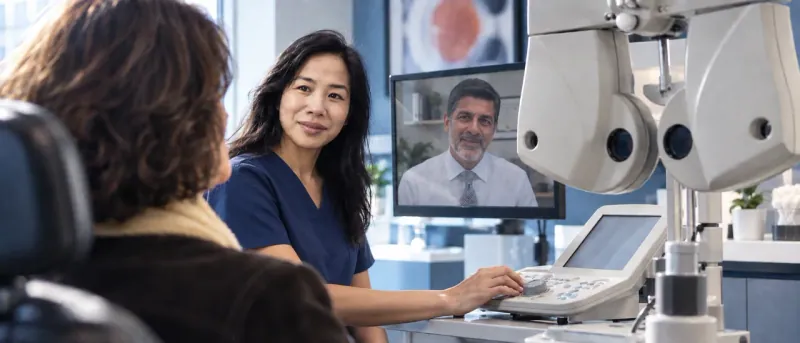
A remote eye exam at AVCC is still an in-clinic visit for you. You come to the vision center, where a trained clinical team member stays with you and supports the hands-on testing. Your eye doctor joins live by video, reviews your measurements and images, talks with you and makes the clinical decisions. You are not taking an eye exam alone at home: you are not remote, the doctor is.
In-office telehealth at AVCC
An in-office eye exam with your doctor connected live by video.
You come to our Aurora or Greensburg office, where staff perform the tests and measurements. Your doctor reviews your results offsite, talks with you live by video, and remotely adjusts the lens-testing equipment and eye chart to check your prescription. In-office telehealth is offered on Fridays for eligible patients ages 18–55. Contact your office to confirm that this visit is right for you. This visit format is not offered in Richmond.
The fee and expected visit time are the same as for the corresponding visit with the doctor physically present.
You visit the vision center with a clinician, the doctor is remote
The word “remote” describes the doctor’s location, not yours. You arrive at the AVCC office that offers this format and use the same kind of clinic space and equipment you would expect during an eye-care visit. An in-office team member is physically present to guide the hands-on parts. The doctor joins through live, two-way video, speaks with you directly and reviews the information collected during the visit.
This kind of care is sometimes called teleoptometry or a hybrid eye exam. It is not the same as an online vision test you take by yourself at home.
AVCC in-clinic remote exam
- Where are you?
- At the vision center
- Who is physically with you?
- A trained in-office clinical team member
- How do you meet the doctor?
- Live video during the visit
- What equipment is used?
- Clinic instruments
- Who makes the clinical decisions?
- The eye doctor
- What if more care is needed?
- The doctor arranges further testing or an in-person visit
At-home online vision test
- Where are you?
- At home or elsewhere
- Who is physically with you?
- Usually no eye-care team member
- How do you meet the doctor?
- Varies: live, delayed or no doctor at all
- What equipment is used?
- Usually a phone or computer
- Who makes the clinical decisions?
- Varies by service
- What if more care is needed?
- Follow-up varies by service
Traditional in-person exam
- Where are you?
- At the vision center
- Who is physically with you?
- The doctor and the clinical team
- How do you meet the doctor?
- The doctor is in the room
- What equipment is used?
- Clinic instruments
- Who makes the clinical decisions?
- The eye doctor
- What if more care is needed?
- The office arranges the next step
How an independent eye doctor inside Walmart works
Who is with you and what each person does
Three people work together during the visit. You share your symptoms, health history, vision goals and questions, and you can see and speak with the doctor in real time.
The in-office clinical team member stays with you, explains each step, helps position you at the equipment and performs or supports the hands-on testing for your visit. The eye doctor reviews the measurements and images, asks follow-up questions, directs the clinical portion of the visit and decides whether a prescription or another next step is appropriate.
Where the office’s system supports it, the doctor may operate or direct connected instruments in real time while the team member helps you at the equipment. The team member does not replace the doctor, and software does not make the clinical decisions.
Walk through the visit, step by step
The exact tests depend on why you are coming in, your history and what the doctor needs to evaluate. A typical visit follows a simple sequence: check in and share your history; complete the in-office testing with the team member; meet the doctor live by video; continue the doctor-led part of the exam; discuss what comes next; and arrange any follow-up that is needed.
At the end, the doctor explains the findings, answers questions and recommends a plan. A prescription may be provided when it is clinically appropriate and allowed for that visit.
No part of this asks you to set up a camera at home, download an eye chart or test your own vision alone.
See what a comprehensive eye exam may include
Bring the same basics, then confirm the visit is a fit
Bring your current glasses and contact lenses, a list of the medicines you take, your eye and medical history, your insurance or benefit information and any questions you want to ask. If the office asks for an earlier prescription or exam record, bring that too. A parent or legal guardian should attend when the office says one is required.
Not every patient or concern is best served by the same visit format. The scheduling team may ask about your age, symptoms, eye history, previous examination, current prescription and whether you wear contact lenses. Those details help the team work out whether an in-clinic remote exam can meet your needs, or whether an in-person doctor visit should be scheduled instead.
If you would rather the doctor were in the room, say so when you schedule. The team can explain which appointment types your office currently offers.
Use the first-visit preparation checklist
Understand what remote care can and cannot finish
A well-designed remote exam gives the doctor real-time conversation, clinic measurements and support from the person in the room with you. Research suggests some remote refraction and visual-function measurements work well for selected adults. The evidence is still too limited to say that every remote model replaces every part of an in-person comprehensive examination for every patient.
That is why the doctor may change the plan after reviewing your history or your results. You may need repeat imaging, dilation, a closer hands-on examination, an in-person follow-up or a referral. That recommendation is part of the care, not a failed visit.
If it is urgent
Some symptoms should not wait for a routine appointment.
Sudden vision loss; a sudden increase in flashes or floaters, especially with a curtain or shadow; severe eye pain with redness or blurred vision; or an eye injury or chemical exposure need urgent care today. Call your office, go to an emergency department, or call emergency services for a life-threatening emergency.
Red eye or sudden vision changes: what to do next
Confirm the practical details before your visit
Ask the office to confirm that your appointment is an in-clinic remote eye exam and which location to visit. You can also ask who will be in the room, how you will speak with the doctor, whether the visit covers the service you need and what happens if the video connection or equipment does not work as planned.
Cost and coverage depend on the service, your benefits and how the visit is billed. Confirm the expected charge and your insurance details with the office before the appointment. For privacy, ask how the video visit is handled and whether anyone beyond the care team can see or hear it. Ask how you will receive any prescription, visit summary or follow-up instructions.
The most useful question is often the simplest: based on why I am coming in, is this the right appointment type for me?
Check costs and insurance first
Common questions
Is a remote eye exam the same as an online vision test?
No. During an AVCC remote eye exam you come to the vision center, use clinic equipment and have an in-office clinical team member with you, and you speak with an eye doctor live. Many online vision tests are self-directed at home and may only check vision or renew a prescription.
Will someone be with me, and can I ask the doctor questions?
Yes. An in-office clinical team member stays with you to guide the hands-on parts of the visit. The doctor joins live by video, so you can talk directly, describe what you are experiencing and ask questions as you would in any other doctor conversation.
What happens if the doctor needs to examine something in person?
The doctor explains why another examination or test is needed and recommends the next step. That may mean an in-person appointment, repeat testing, dilation or a referral to another eye-care professional. The visit should end with a clear plan rather than leaving you to decide alone.
Sources: in.gov, iga.in.gov, aoa.org, ncbi.nlm.nih.gov, nei.nih.gov
Clarity before commitment
Start with what the visit includes.
No insurance? You can still ask about care. Compare the visit, the fee, and what is separate before sharing contact details.
- Cost
- $95 self-pay Eyewear, contact lens fitting and additional testing are separate.
- When
- You choose the days Share your preferred days. The office confirms a time.
- Time to allow
- 30 to 45 minutes Total time onsite, including check-in.
Helpful guides
Answers for the step you’re on.
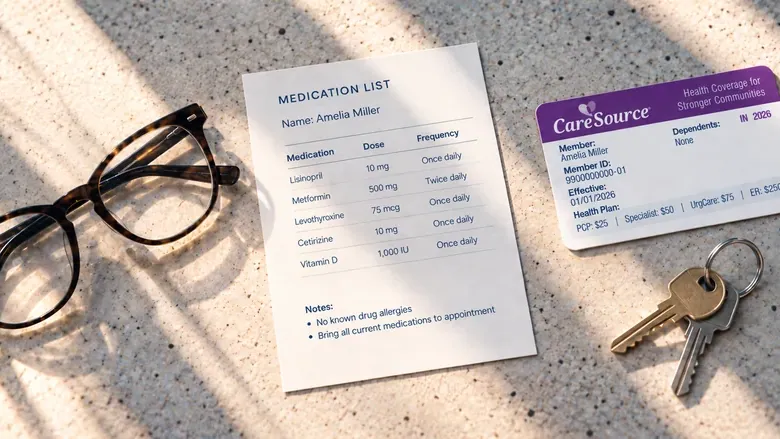 Your first AVCC visit: a simple preparation checklistKnow what to confirm, what to bring and which questions to ask about cost, time and the next step before your first visit.
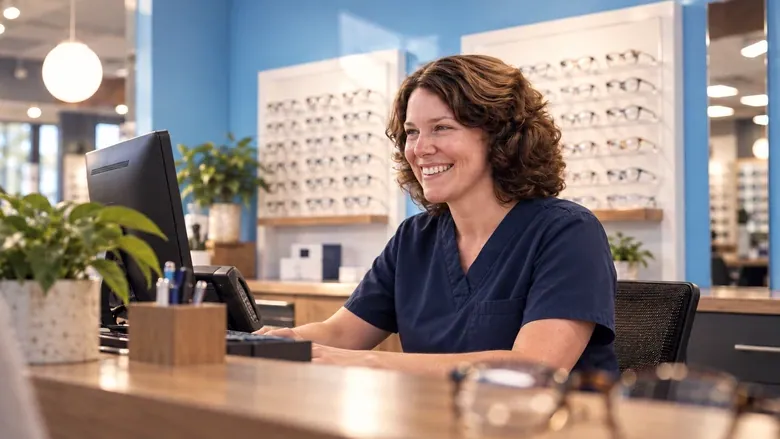 An independent eye doctor inside Walmart: how AVCC visits workKnow which team handles the eye exam, where to find your AVCC office and how to keep clinical care separate from eyewear shopping.
 Red eye or sudden vision changes: when not to wait for an online requestSome eye symptoms need immediate help, not a routine request. Recognize warning signs and communicate clearly without trying to diagnose yourself.