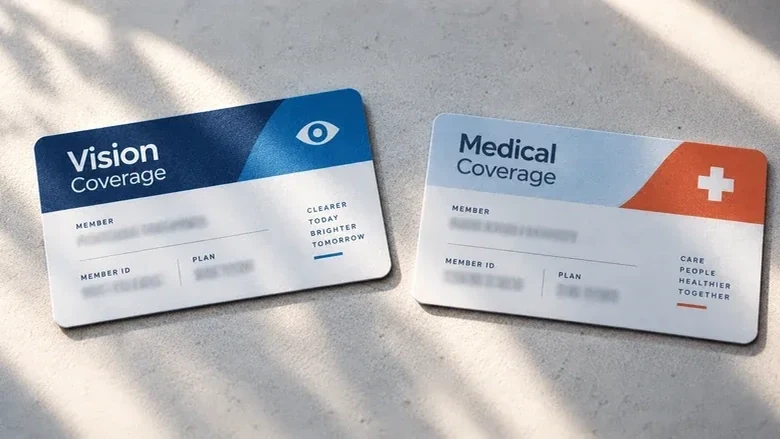
Reviewing next year's benefits? Add these eye-care questions
Bring specific eye-care questions to your next benefits review. Check the actual plan, service, clinician and office before assuming coverage.

When reviewing benefits for the next coverage year, start with the care your household expects to need and the providers you want to use. Then ask about the exact plan's network, covered services, patient costs and effective date. An insurer's familiar name does not answer those questions by itself.
List the care questions your household has
Think separately about routine eye examinations, contact lens fittings, glasses or lens supplies, and monitoring or treatment of an eye condition. You do not need to predict every future service. A short list gives the benefits administrator a concrete starting point.
Describe care accurately when speaking with an office, too. A prescription update and a visit about a medical concern can raise different billing questions. AVCC's guide to vision and medical insurance explains why one card does not describe every part of eye care.
AVCC's guide to vision and medical insurance
Check the provider, office and exact network
Find the full plan name and network in the enrollment materials. Ask the insurer about the clinician at the location you intend to use, then ask that office to check its participation information. Keep the date and reference number for the insurer's answer.
For AVCC, identify Aurora, Greensburg or Richmond and the expected service. A practice listing or logo does not prove that every plan sold by an insurer applies to every doctor and location. If details conflict, resolve the specific question before relying on the answer for your budget.
Aurora, Greensburg or Richmond
Distinguish routine benefits from medical coverage
Ask which benefit applies to the examination, fitting, additional testing and eyewear. Look for frequency limits, referral or authorization requirements and any separate rules for providers outside the network.
Medicare illustrates why the distinction matters: Original Medicare does not cover routine refractions for glasses or contacts, while Part B has an eligibility-dependent diabetic-retinopathy exam benefit. Some Medicare Advantage plans offer additional vision benefits. Those examples do not determine your plan's benefits or AVCC participation.
Compare the costs you may actually pay
Ask about premiums, deductibles, copayments, coinsurance and eyewear allowances as applicable. Request an explanation of how the benefits would apply to the services on your list. Keep examination and eyewear budgets separate rather than assuming one allowance pays for both.
If you use a health FSA or HSA, ask the administrator about eligible expenses, documentation and your account's rules. IRS Publication 969 describes these arrangements. An HSA balance can carry forward; an FSA has different plan-year rules and may have an employer-provided carryover or grace period. Check current rules without relying on last year's limits.
Confirm when new coverage begins
Write down the effective date and how to obtain updated benefit information. A plan chosen during enrollment may not be active for an appointment occurring before that date. Tell the office about any change before the visit and ask what needs to be checked again.
Use AVCC's costs and insurance page to prepare the office conversation. Coverage verification helps planning but does not guarantee claim payment. A benefits inquiry or appointment request is not a confirmed clinical appointment.
AVCC's costs and insurance page
Common questions
Can AVCC choose the best plan for me?
Ask the office about its services and participation. Your plan or benefits adviser should explain enrollment options for your household.
Is the insurer's name enough to verify coverage?
No. Check the exact plan/network, clinician, office and proposed service.
Should I use next year's benefit limits now?
Use the rules and effective date for the actual service date. Recheck any future-year figures when they are officially available.
Sources
- Eye exams (routine) (Medicare)
- Eye exams (for diabetes) (Medicare)
- IRS Publication 969
What your visit includes.
No insurance? You can still ask about care. Compare the visit, the fee, and what is separate before sharing contact details.
- Cost
- $95 self-pay Eyewear, contact lens fitting and additional testing are separate.
- When
- You choose the days Share your preferred days. The office confirms a time.
- Time to allow
- 30 to 45 minutes Total time onsite, including check-in.